
Long-term Effects of the Increasing Trend of Nuclear Families
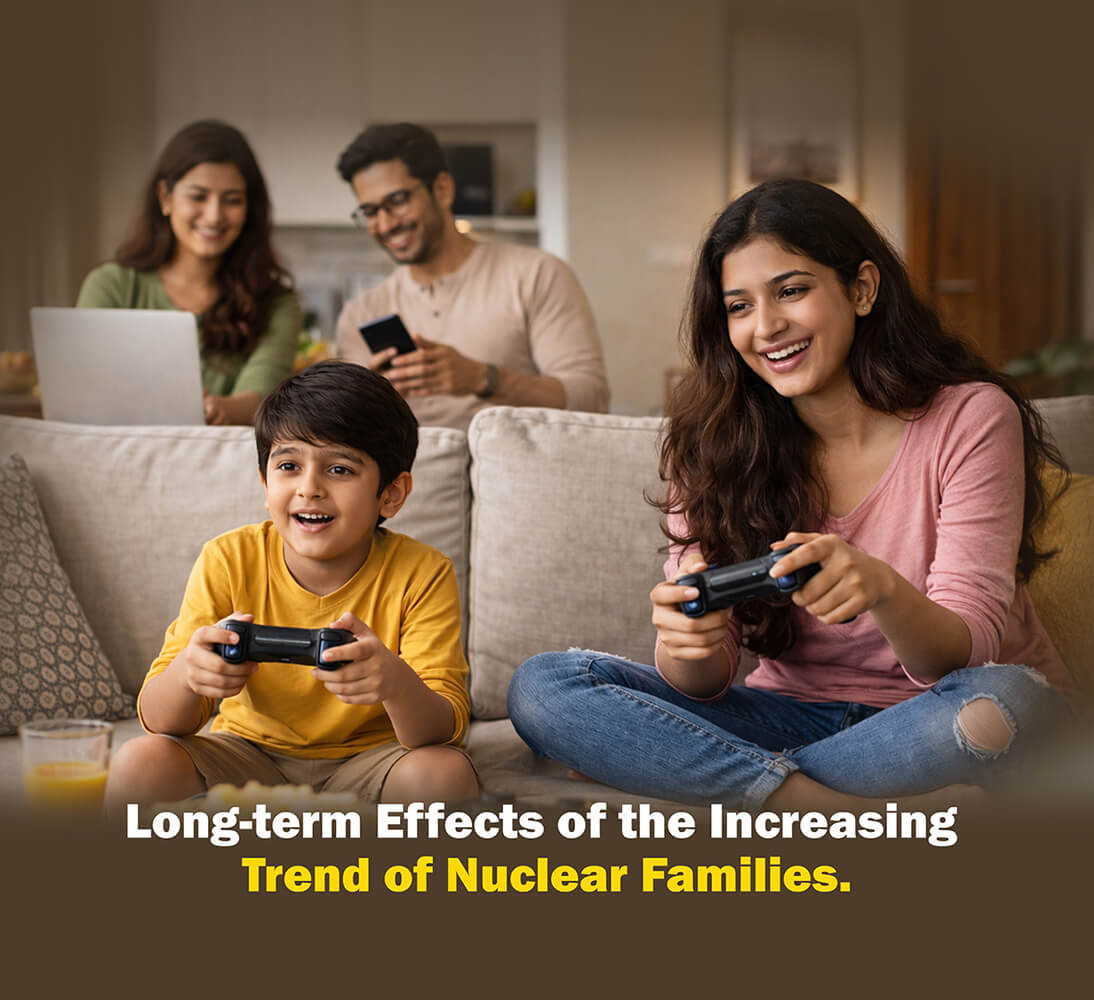
No amount of praise is enough for the joint family system of our country, India, which possesses a great culture. Amidst today's constantly changing circumstances and fading life values, finding a completely happy and ideal joint family has become exceedingly rare. However, when such families are occasionally spotted—like a sweet well in a salty desert—it brings peace to the heart. These families provide a new ideal for today's younger generation.
Since ancient times, the family has been considered the foundation of society. For human society, the family is an essential, secure, and ideal institution; however, its roots have begun to shake in recent years. Because of this, the United Nations declared the year 1994 as the “International Year of the Family.”
Due to modernization, industrialisation, and urbanization, nuclear families have begun to increase. In today’s materialistic era, every individual has started giving importance only to personal self-interest; they have no time to think of others. As a result, individuals have moved away from the joint family. In a joint family, parents, grandparents, and siblings all come together to share in each other's joys and sorrows.
This is its unique characteristic. Even if someone's physical or mental abilities were greater or lesser, everyone flourished together. Children’s development could also take place in a healthy environment filled with affection and warmth. Today, due to the growing selfish mindset of "we two, our two" or "we two, our one" (single child), the number of family members is becoming limited day by day. In the future—and to some extent even today—a situation will arise where we may have to search far and wide to introduce our children to relationships like siblings, uncles, aunts, cousins, and nephews. The sweetness that used to exist in all these relationships is no longer there. In a joint family, there is a greater nurturing of virtues and values. On the other hand, living in a small family sometimes leads to a loss of traditional values and morals.
This state of families is the result of consumerism and an individualistic culture. In this era of globalisation, parents feel very happy when their children settle abroad after getting a higher education; however, after some time, this happiness often turns into sadness. The mindset of today's children has also changed. They listen to their parents only until they become self-reliant; after that, their ego grows so much that they consider following their parents' advice as something beneath them. The moral values found in grandmother’s lovely stories are now being discarded as obsolete. It seems that the role of elderly people in the house is now limited only to babysitting small children. In a joint family, a child’s social development is very strong, whereas, in a nuclear family, this growth remains incomplete, and a sense of loneliness prevails.
Children and the elderly suffer the most from these breaking families. Family life has played a major role in the achievements of human society. Economic downturns are also felt less in joint families. The impact of the severe global economic recession in recent years was felt more in the US and European countries because of the nuclear family system. In contrast, India was able to stand firm against that economic storm due to its joint family tradition. Therefore, it is essential to preserve joint families because they are our unique identity. In difficult times, one finds love and warmth in a joint family.
Many families have been destroyed by internal conflicts, leading to an increase in nuclear families. This separation has reached a point where even if there is only one son, the parents have to live separately! There are countless such examples. Elders should teach their children about the benefits of a joint family, married life, tolerance and the key to happiness through compromise.
The lifestyle of nuclear families has snatched away the childhood of kids who used to play in the laps of their grandparents and listen to lullabies, making them addicted to TV and mobile phones instead. People have started believing that a lonely life is true happiness and the ideal!
A joint family brings economic stability, preserves cultural values, and strengthens emotional bonds. Even a weaker member of the family is supported. Unexpected expenses do not cause a crisis, and members can help each other during both good and bad times. Unity is a collective strength; this strength increases power, and power provides security. A joint family succeeds in facing any trouble during tough times, while members of a nuclear family always remain dependent on outsiders.
The broken family system is also a reason for the rising crimes in society, mental illnesses, and the increasing suicide rate among youth. Nuclear families will also prove fatal to our Sanatan culture. The tradition of supporting each other in times of crisis will weaken. Various customs and traditions of our culture will gradually disappear and eventually, the situation will become dangerous for Sanatan Dharma itself. Its effects will also be seen in religious, social, and educational institutions. Because of this, there is a need to rethink the country's family planning and population policies to maintain a balance. All communities must work together to increase unity and cooperation; only then can we protect our religion and culture. In short, if religion is protected, everything else will be preserved.